The Poverty of Information

The Poverty of Information: Why You Can Know Everything About God and Still Be a Stranger to Him
1. The Information Trap
We live in an era where we are constantly being "discipled" by the world around us. Our phones beg for our attention from the moment we wake, and a relentless stream of culture whispers into our ears, shaping our desires and fears. In response, many of us have become curators of spiritual data. We fill our shelves with theological treatises, our queues with podcasts, and our notebooks with insights. Yet, there is a haunting disconnect that remains: it is entirely possible to collect a vast library of information without experiencing a single ounce of personal transformation.
The Apostle Paul recognized this gap nearly two millennia ago. Writing to the Ephesians—a community already marked by faith and love—he did not offer them a new reading list or a more complex set of data. Instead, he prayed. His prayer reveals that the greatest hurdle in the Christian life is not a lack of "theological vocabulary," but the distance between a head full of facts and a heart that truly knows the Person behind the prose.
2. Knowing About vs. Knowing Personally
Biblical knowledge is fundamentally different from the way we gather facts about a hobby or a historical figure. According to the source, it is possible to be a consummate expert in doctrine while remaining a total stranger to the God that doctrine describes. We can master the map without ever stepping foot into the country.
"There are plenty of atheists that know a lot about the God they believe does not exist. You can know theological vocabulary... but biblical knowledge is meant to bring us into a deeper relationship with God."
It feels counter-intuitive that "genuine Christians" would need to pray for knowledge. We assume that once we have "the facts" of the Gospel, we have arrived. But Paul’s burden suggests that while information is the necessary starting point, the goal is "knowledge of Him." We must move beyond the static realization that a truth is "factually correct" and allow the Spirit to illuminate the profound significance of that truth until it shifts the very foundations of our souls.
3. Your Identity: A Gift, Not a Project
Our modern culture treats identity as a high-stakes manufacturing project. We are told that we must build ourselves out of our professional titles, our family roles, or our curated successes. This leaves us on a shifting foundation, where our sense of self is only as stable as our last performance.
Paul offers a radical alternative: identity is not something you manufacture; it is "something God has given you in Christ."
- In Christ: You are not your failures or your highlight reel. You are chosen, adopted, and redeemed.
- The Sealed Identity: This identity is not a fragile thing you must protect; it is "sealed" by the Holy Spirit and guaranteed by God Himself.
- A Finished Work: Because this identity is a gift rather than a project, it provides the internal stability needed to face a world that is constantly trying to redefine who you are.
4. The Practice of "Grace-Hunting"
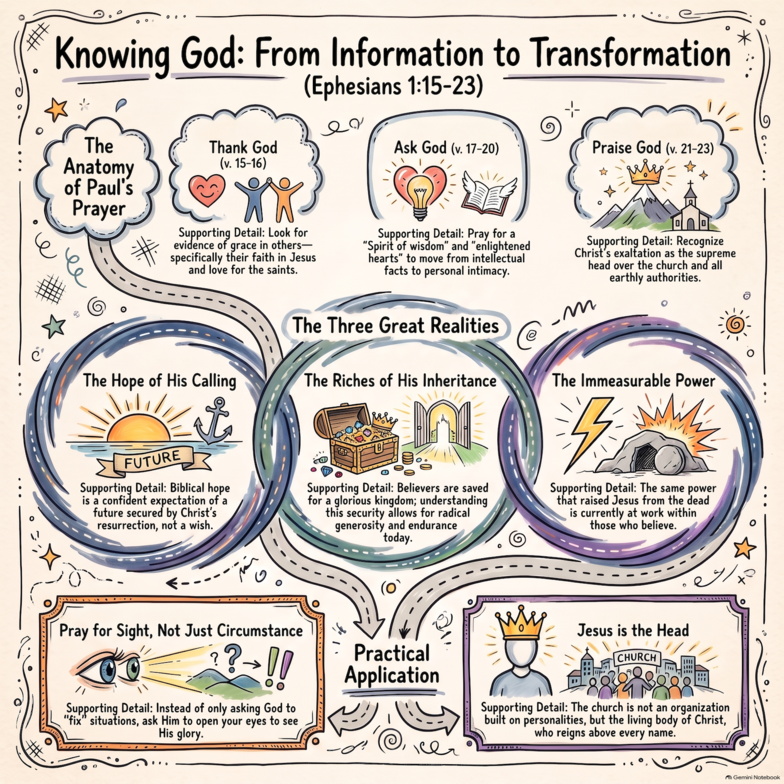
We are naturally wired to be "better at seeing what is wrong" than seeing evidence of God’s work. We walk into a room and notice if the temperature is off, the music is too loud, or the chairs are uncomfortable. To counter this, we must adopt the practice of "grace-hunting." This is Paul’s methodology: he begins not with a list of grievances, but with a relentless search for evidence of God’s grace in others.
This practice is the engine that builds a "new family." It requires us to look past our preferences and thank God specifically for "the people you don’t naturally understand" or those who are "difficult to love." When we look for grace, we see a community being built out of people from vastly different backgrounds, unified not by their similarities, but by their Savior.
Evidence of Grace to Look For:
- The miracle of people from different backgrounds praying for one another.
- The quiet, unheralded service of those seeking no recognition.
- Homes being opened to strangers and neighbors for the sake of the Gospel.
- The faithful, patient teaching of the next generation.
- A genuine love for "all the saints," especially those who challenge our comfort.
5. Spiritual Paupers in a Land of Plenty
The most jarring reality of the human condition is our tendency to live as "spiritual paupers" while being surrounded by an inheritance of "immeasurable greatness." We walk through life defeated, anxious, and spiritually hungry, not because the blessings are absent, but because we fail to recognize them.
I want to offer a sobering contrast: I stand in a pulpit in a free city, preaching the Word without the fear of being abducted by a terrorist group. This is profound evidence of grace, yet it is often ignored. To bridge this gap, we need what Paul calls the "Eyes of the Heart." This is the spiritual mechanism that allows us to move beyond physical sight and see our lives through the lens of God's abundant provision.
"...and what is the immeasurable greatness of his power toward us who believe, according to the working of his great might that he worked in Christ when he raised him from the dead."
6. Hope is a Historical Fact, Not a Wish
In our everyday language, "hope" is a fragile thing—a wish that things might go our way, like "hoping it doesn't rain." Biblical hope, however, is a confident expectation rooted in a historical event: the resurrection of Jesus Christ.
This is not a vague optimism; it is a "living hope" that remains steady even when we are burying loved ones or facing unanswered questions. Because the tomb is empty, we have a certainty that death does not have the final word. This historical fact allows us to endure the deepest disappointments of a broken world, knowing that history is moving toward God’s appointed, victorious conclusion.
7. Power Redefined: Strength for the Unchanged Circumstance
We often mistake biblical power for a "prosperity gospel" tool—a means to secure a promotion, wealth, or an easier path. But the power that "raised Jesus from the dead" is often demonstrated most clearly in our weakness.
Remember Paul’s "thorn in the flesh" (2 Corinthians 12). God’s power was not shown by removing the thorn, but by providing a grace that was sufficient to endure it. True biblical power is the strength to remain faithful in circumstances that do not change. It is the power to trust God when the situation remains painful, knowing that His strength is made perfect in our limitations.
8. Conclusion: Moving Beyond the Notes
The ultimate aim of the Christian life is not to accumulate "pages of notes," but to allow the knowledge of God to permeate our marriages, our workplaces, and our private thoughts. We are called to move from merely possessing these blessings to truly understanding what we have. When the eyes of our hearts are opened to the reigning, exalted Christ, our only logical response is worship. Ask yourself today: Do you merely possess these theological facts, or do you truly understand the riches of what you have in Christ?

-
Location