Beyond Self-Help

Beyond Self-Help: 4 Counter-Intuitive Truths About Human Transformation
1. Introduction: The Self-Improvement Trap
Almost everyone knows the exhausting friction of the self-improvement loop: identifying a destructive habit or relational pattern, making a solemn vow to change, and then falling back into the very behavior they pledged to abandon. It is the classic human predicament articulated by the apostle Paul in Romans 7:15: "For I do not understand my own actions. For I do not do what I want, but I do the very thing I hate." Head knowledge and good intentions consistently fail to supply the internal power required to execute lasting change.
Modern culture tends to approach human transformation like assembling IKEA flat-pack furniture. We operate under the tacit assumption that if we are given a sufficiently detailed instruction manual, work a little harder, and ignore the three extra screws left lying on the floor, we can construct a functional life through sheer willpower and effort.
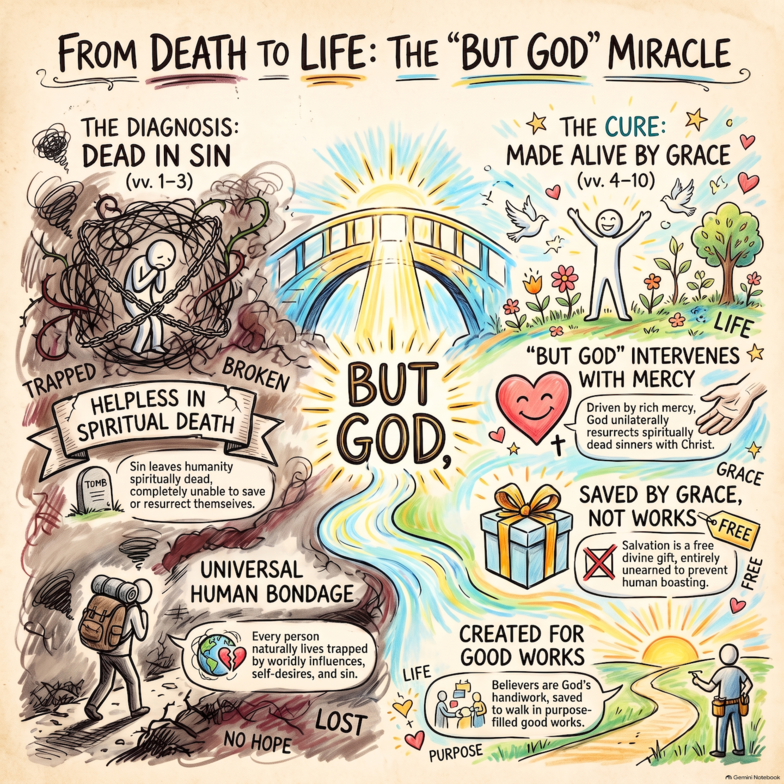
Ephesians 2 delivers a radical diagnosis that shatters this self-help paradigm. The fundamental human problem is not a lack of information, bad direction, or an operational defect that can be managed through better habits. Humanity’s core affliction is spiritual death. True transformation cannot begin with self-improvement protocols because a dead entity cannot follow instructions.
To move beyond the exhaustion of self-effort, we must understand four counter-intuitive truths that completely reframe how human transformation actually occurs.
2. Takeaway 1: You Aren’t "Sick"—You’re Dead (And Instructions Can't Resurrect a Corpse)
Human nature inclines people to divide the world into moral tiers, comfortably placing themselves in the "basically good" category while viewing destructive behaviors as occasional, temporary missteps. Ancient scripture dismantles this flattering self-assessment, declaring that apart from divine intervention, every person shares the exact same starting diagnosis: "And you were dead in the trespasses and sins in which you once walked."
The original language uses the word nekros—literally a corpse, an entity devoid of breath, motion, or self-generated capability. This diagnosis does not mean unregenerate individuals are physically immobile or intellectually inactive. They breathe, build careers, raise families, make moral choices, and navigate complex cultural systems. Yet spiritually, they remain fundamentally dead to God, incapable of generating the spiritual life He requires.
This spiritual deadness is maintained by a formidable, three-fold system of bondage: the World (a pervasive cultural matrix aligned against God), the Devil (the hidden spiritual power operating in rebellion), and the Flesh (internal corrupted passions and distorted desires of the mind and body). Trapped within this triad, human willpower is completely outmatched.
This is why self-help models break down at the deepest level. A sick person needs medicine or a adjusted diet, but a corpse inside a tomb cannot utilize a regimen. Consider Lazarus in John 11: he was not inside the cave weighing his options, trying harder, or executing a steps-to-recovery plan. He was helpless. A corpse inside a grave does not need a motivational speech or a clearer checklist; it requires a resurrecting command.
"A dead person doesn't need a motivational speech. A dead person doesn't need someone saying, 'Try harder.' We don't need a better set of instructions; a dead person needs a resurrection miracle."
Confronting the reality of Spiritual Death redefines the entire objective of human transformation, shifting our pursuit from self-reformation to Resurrection over Improvement. Transformation is not about teaching dead people to behave better; it is about dead people being brought to life.
3. Takeaway 2: The Pivot Point of Human History Rests on Two Words: "But God..."
After establishing the stark reality of human deadness, slavery to internal and external powers, and dynamic subjection to righteous judgment, the narrative reaches the ultimate hinge point of human history in verse 4.
The entire trajectory of human destiny turns upon two words: "But God..."
This pivot point contains precisely zero human initiative. The text does not say, "But you got your act together," "But you became religious," or "But you finally tried hard enough to clean up your life." The turning point is entirely external and completely unilateral.
"We were dead—but God. We were enslaved—but God. We were separated—but God. God didn't wait for us to become spiritually attractive; He acted when we were dead."
This divine rescue is driven entirely by God’s rich mercy and great love. Mercy holds back the judgment human sin deserves, while grace bestows the unearned favor no human could ever merit. Crucially, God did not wait for humanity to become morally attractive, spiritually organized, or cooperative before acting. He intervened while humanity was still completely dead in transgressions.
The spiritual engine of this intervention is Union with Christ. Salvation is not an abstract legal transfer conducted at a distance; it is an organic, spiritual identification with Jesus. Ephesians reveals that God made us alive together with Christ, raised us up with Christ, and seated us with Christ in the heavenly places.
This positional elevation shifts the believer's core identity from an orphan decaying in a tomb to royalty seated in the realm of reigning grace. Because the believer is united to Christ in His resurrection and ascension, the past no longer possesses the final word, sin no longer exercises absolute dominion, and personal identity is permanently anchored in Christ's triumphant status.
4. Takeaway 3: You Are a "Poiēma": You Are Saved For Good Works, Not By Them
Ephesians 2:8–10 clarifies the essential mechanics of spiritual vitality by drawing a sharp line between working to earn acceptance versus working from acceptance. Human salvation is secured entirely by grace through faith—it is the gift of God, explicitly excluding human works so that no individual can boast.
Yet being saved apart from works does not mean the resurrected life remains passive or formless. Humanity is brought to life for a specific design, captured in the Greek word poiēma—translated as "workmanship," "masterpiece," or "poem."
Picture a master sculptor standing over a rugged block of marble, systematically chipping away everything that conceals the masterpiece within. The resulting sculpture does not earn its right to exist by posing proudly on its pedestal; it exists purely because of the vision, skill, and persistent grace of the artist. Once formed, the sculptor displays the piece and assigns it a purpose.
"We are not saved because we do good works. We are saved for good works. Grace comes first. Life comes first."
This order can never be inverted. Works do not generate life; life produces works. This synthesis echoes the historic theological axiom: "It is faith alone that justifies, but faith that justifies can never be alone" (a reality emphasized in James 2:26). Real faith is inherently living and functional.
Furthermore, the pre-prepared "good works" of the resurrected life are rarely theatrical, heroic exploits. More often, they consist of ordinary daily faithfulness: patiently raising children, loving a spouse when it is demanding, serving others without demanding recognition, forgiving enemies, and executing daily work with integrity. These quiet acts are the visible artifacts of a master artist at work.
5. Takeaway 4: The Danger of Intellectual Assent (The "Satan Test")
Perhaps the most sobering threshold in understanding spiritual transformation is the absolute distinction between mental agreement with factual truth and true spiritual regeneration. Knowing the right facts about God does not mean one possesses the life of God.
Consider a thought experiment involving an interrogation of Satan himself before a cosmic tribunal. If asked, "Do you believe in one God?" he would answer, "Of course I do." If asked, "Do you believe Jesus Christ is the Son of God, born of a virgin, crucified for sinners, and resurrected on the third day?" he would reply, "Unquestionably, I witnessed it firsthand." Even if pressed, "Would you outwardly encourage service or sacrificial giving to religious institutions?" he could assent, recognizing that empty religious routine often lulls human souls into false security.
However, when confronted with the one ultimate question—"Will you bow to the Lordship of Jesus Christ over your life?"—his response is immediate and absolute: "No, I will never bow."
This thought experiment unmasks the profound illusion of passive, intellectual religion. An individual can possess impecable theological knowledge, affirm historical creeds, adopt conservative moral codes, and participate in church life, yet remain spiritually dead (nekros).
Faith is not merely storing orthodox data in one's intellect or refining external moral habits. Factual agreement without surrender is simply the theology of demons. Genuine spiritual resurrection requires the surrender of the human will—yielding total control to Christ as Lord, rather than merely nodding along to a set of spiritual propositions.
6. Conclusion: From the Grave to Grace
Human transformation can never be manufactured through self-help checklists, behavioral modification, or the spiritual equivalent of assembling IKEA furniture. Human effort cannot raise a spiritual corpse from the grave.
The core message of human transformation is that divine power takes us from the grave to grace, from spiritual deadness to positional royalty in Christ, and from aimless self-preservation to walking in pre-prepared purpose as God's poiēma.
This leaves every individual with a fundamental question to consider: Are you still relying on your own self-improvement attempts to fix a condition that requires a miracle, or have you yielded your will to Christ and been truly made alive?

-
Location