Beyond Concrete and Fear

Beyond Concrete and Fear: 5 Surprising Lessons on How Walls Come Down
Human beings have an extraordinary knack for building barriers. Some of these structures are practical and protective; we put up fences around our homes, pour concrete retaining walls to hold back eroding earth, or construct city walls to protect communities from harm.
Yet the most formidable barriers in our lives are entirely invisible. They are forged out of fear, suspicion, generational offenses, and pride. These silent walls dictate who we trust, whom we exclude, and where our loyalties lie. Once erected, they feel almost impossible to dismantle through sheer human effort.
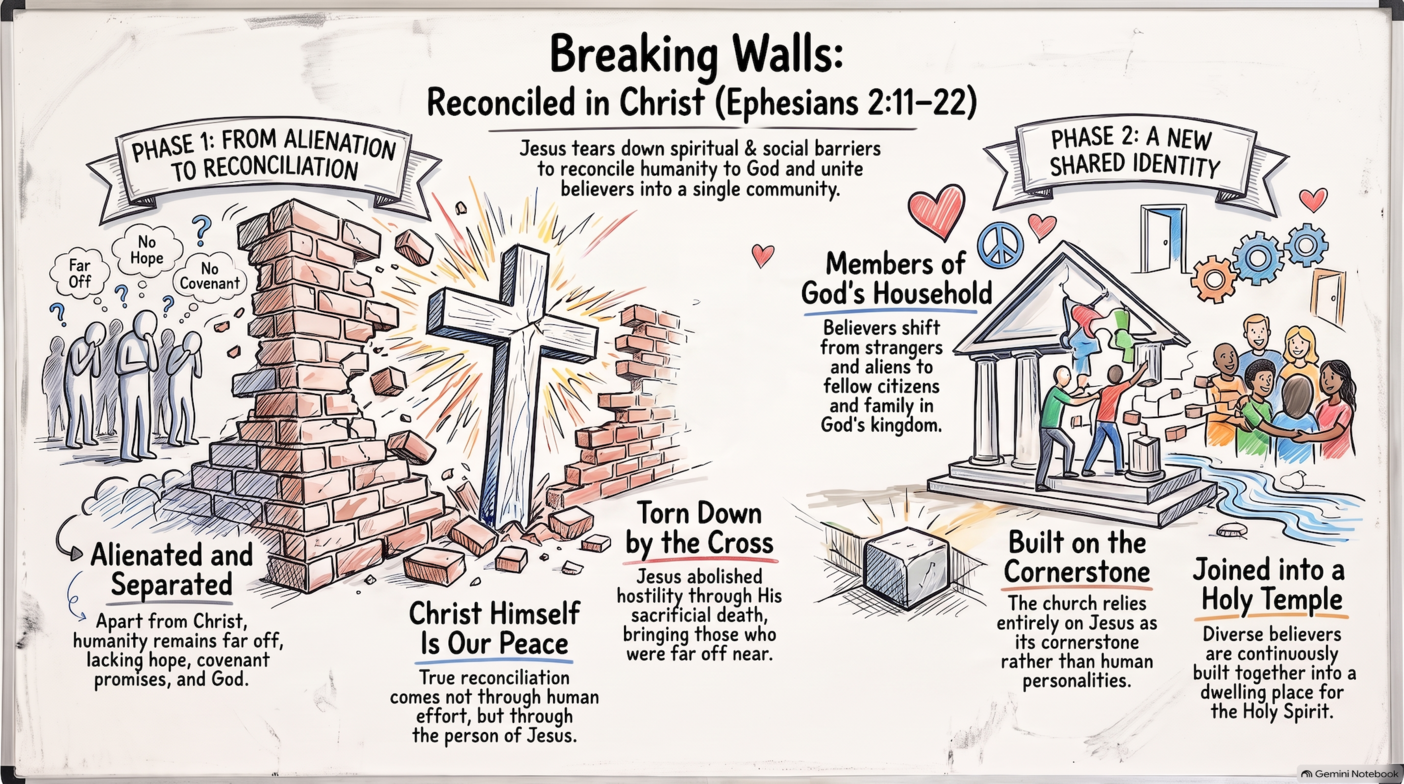
Ephesians 2:11–22 shows how the cross of Jesus Christ tears down deep spiritual and relational divisions, not diplomatic compromise or cultural goodwill. Paul’s ancient letter reveals five transformative takeaways about our shared alienation, genuine reconciliation, and what it truly means to belong to a new humanity.
Invisible Barriers Outlast Concrete Ones—But They Can Fall in an Instant
The Berlin Wall stands as one of modern history's most striking physical symbols of division. Constructed by East German authorities in August 1961, it sliced directly through neighborhoods, cut off bustling streets, and separated families for nearly three decades. Armed guards, watchtowers, and barbed wire reinforced a stark psychological reality.
Even after President Ronald Reagan delivered his historic 1987 speech at the Brandenburg Gate—demanding, "Mr. Gorbachev, tear down this wall!"—the barrier seemed immovable. Yet on November 9, 1989, following a confused government press conference, thousands of East Berliners gathered at border checkpoints. At Bornholmer Straße around 11:30 PM, overwhelmed guards stood aside, and roughly 20,000 people crossed the bridge in a single hour, embracing one another.
Centuries before Berlin, physical barriers signaled similar exclusion. Historical accounts from Josephus note that the Jerusalem temple featured a stone barrier with Greek and Latin inscriptions explicitly warning Gentiles that passing the line meant immediate death. Whether made of stone or concrete, physical walls send an unmistakable message.
"A wall tells you which side you are on. A wall says: 'You are not one of us.' 'You stay over there.' 'We stay over here.'"
While physical walls eventually crumble, invisible barriers between spouses, family members, ethnic groups, and even church members often prove far more durable. Built on fear or pride, these unwritten boundaries quietly isolate us on opposite sides of a room.
Separation Is Deeper Than Mistakes—It’s an Identity Crisis of "Outside Looking In"
When the Apostle Paul addresses Gentile Christians in Ephesians 2:11–12, he urges them to remember their former spiritual reality. He pulls no punches, describing them as "separated from Christ," "alienated," "strangers to the covenants," "having no hope," and "without God in the world."
Paul deliberately avoids soft, comforting language. He does not suggest that humanity was slightly confused or needing minor moral self-improvement. Instead, he paints a sobering picture of total spiritual displacement and isolation.
Sin is not simply a list of isolated mistakes like losing one's temper or telling a lie. As Isaiah 59:2 reminds us, our iniquities create a fundamental chasm between us and our Creator, leaving us spiritually dead (Romans 3:23, 6:23).
Grasping the sheer depth of this alienation is the necessary doorway to understanding grace. Christianity inherently begins with deep humility—we cannot truly celebrate mercy while secretly believing we were entitled to it all along.
Real Peace Isn't a Compromise or a Policy—It’s a Person
The entire landscape of Ephesians 2 shifts on two monumental words in verse 13: "But now." These two words bridge the chasm between spiritual death and life, announcing that those who were once far off have been brought near by the blood of Christ.
In the ancient Mediterranean world, the hostility between Jew and Gentile was intense and deeply entrenched. Yet this divide was not breached because the two groups negotiated a political treaty, applied social pressure, or simply learned to appreciate their cultural differences.
Instead, verse 14 makes a revolutionary claim: "For he himself is our peace." The text does not say Jesus merely brokered peace or distributed a policy of peace; it declares that Jesus is peace. Through His flesh on the cross, He broke down the dividing wall of hostility to create "one new man"—a single unified body where background distinctions no longer determine spiritual standing (Galatians 3:28).
Furthermore, verse 18 reveals the beautiful Trinitarian shape of this rescue: through Christ, by one Spirit, we gain direct access to the Father. Reconciliation gives us immediate intimacy with the God who once seemed infinitely far away.
The Gospel Destroys Entrenched Hatred in Ways Human Effort Cannot
To show how the cross conquers systemic hostility, Joby Martin describes a baptism service held inside a maximum-security prison.
After the leader of a Black prison gang was baptized in a portable tub, the minister asked if anyone else wanted to surrender to Christ. A massive man covered in white supremacist tattoos, including a prominent swastika on his neck, stood up and entered the water. As he emerged from the baptismal waters, the unexpected happened.
"The leader of the Black gang embraced him and looked at the other men there and said, 'It ends today.' The years of gang wars in the prison ended that day."
This moment embodies the practical power of John 13:35, where Jesus promises that the world will recognize His disciples by their love for one another. The church is meant to be a living collision of diverse backgrounds, preferences, and histories—a community that makes zero human sense apart from the supernatural work of Christ.
You Are Not Saved to Be an Isolated Believer, But a Living Blueprint
Salvation in Christ is never a purely private or individual affair ("what Jesus does for me"); it is fundamentally corporate ("what Jesus does with us"). In Ephesians 2:19–22, Paul presents three vivid pictures of our new collective identity:
- Citizens: Believers are fellow citizens with the saints, possessing a heavenly citizenship that supersedes earthly tribalism (Philippians 3:20).
- Members of the Household: We belong to God's immediate family, shifting our posture from passive consumers to active family members who carry one another's burdens (Galatians 6:10).
- A Holy Temple: God’s dwelling place is no longer a physical building of mortar and stone, but a living structure composed of His gathered people, anchored by Jesus Christ as the cornerstone (Matthew 16:18).
Living as a living temple also means acknowledging real human messiness. When believers are "built together," relational friction naturally occurs—misunderstandings arise, differences emerge, and people occasionally disappoint us. Yet, even through those imperfect interactions, God continues joining us together into a holy sanctuary indwelt by His Spirit.
Conclusion: Two Words That Change Everything
The divine architecture of Ephesians 2 traces a clear spiritual movement for every believer:
  ALIENATED:   --->    RECONCILED:   --->    IDENTIFIED:
  Far off from         Brought near          Built together
  God & Hope           by the cross          in the Spirit
Translating this ancient truth into modern daily life requires three clear, active commitments:
- Remember where you came from: Keep the wonder of grace alive by remembering the pit you were rescued from, without remaining trapped in shame (Titus 3:3–7).
- Move toward people Christ has brought near: Refuse to nurture personal bitterness or maintain silent walls. Actively pursue peace and forgiveness while walking in truth and wisdom (Romans 12:18).
- Live like you belong: Step into your local church as a true family member—serve, pray, encourage, and invite others so they too might discover their true home in God.
Every transformed life rests on those two powerful words: "But now." You may have once felt isolated, far off, or trapped behind invisible walls of fear and history—but now, in Christ Jesus, those barriers have been dismantled. Take a moment to ask yourself: What wall are you still holding onto that Jesus has already torn down at the cross?

-
Location