The Alter of Promise

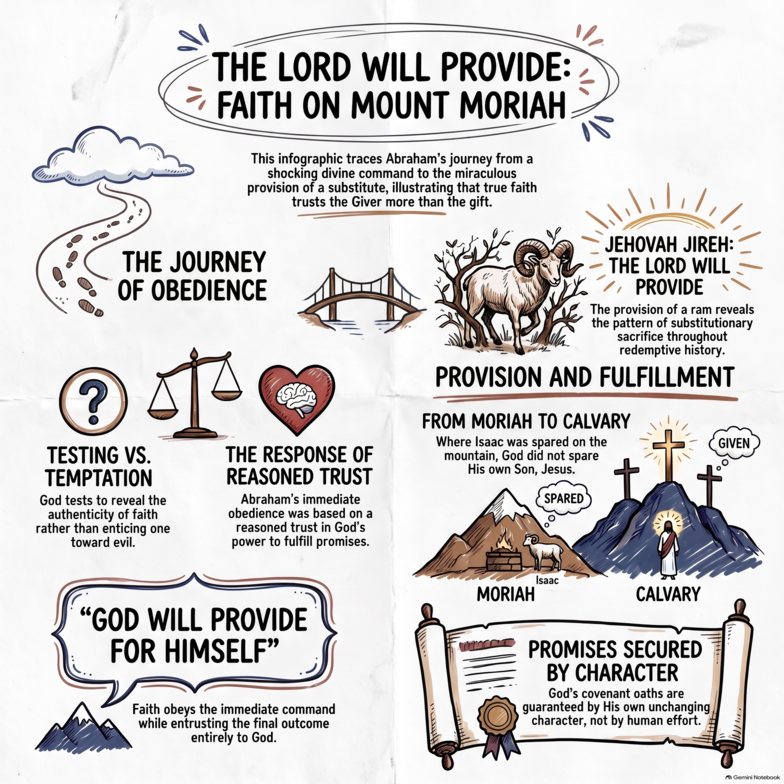
The Altar of Promise: What to Do When God Asks for Your "Isaac"
1. The Phone Call You Never Expected
Imagine your phone rings early in the morning. You glance at the screen and see your doctor’s office. You answer, and after a brief, heavy pause, you hear the words no one is ever prepared to hear: "I'm sorry... we found something."
In an instant, the world stops. The promotion you were chasing, the vacation you saved for, and the projects filling your calendar don’t just move to the background—they fade into an abyss. Whether it is a medical report, a phone call about a child’s accident, or a business owner watching decades of work disappear overnight, life has a way of exposing our foundations.
That sinking feeling in your stomach is more than a reaction to bad news; it is the sound of a promise being placed on an altar. It is the moment God places His finger on the thing you treasure most and asks: "Do you trust Me?"
Genesis 22 presents the climactic moment in the life of Abraham where God’s promises and His commands seem to collide in a violent contradiction. God had promised that Abraham’s offspring would be named through Isaac (Genesis 21:12), yet He then commanded Abraham to offer that very son as a burnt offering. This tension is a deliberate theological pattern designed to reveal the true nature of covenant faith.
2. Tests Are Not Temptations
The narrative explicitly identifies this event as a test, not a temptation. It is vital to understand the theological distinction: God never entices His people to evil, but He frequently tests them to reveal the authenticity of their faith and where their confidence truly rests.
This follows a consistent pattern found throughout the Pentateuch. In Exodus 16:4, God tested Israel through the provision of Manna. The test was not merely about hunger; it was about whether they would gather a "day’s portion" in trust or gather more than needed out of a fear-driven desire for self-preservation. As Deuteronomy 8:2 suggests, God leads us into the wilderness to "test you, to know what was in your heart." Testing is the primary means by which the reality of our relationship with God is made manifest to us.
3. The Idolatry of Good Things: Recognizing Your Modern "Isaac"
Abraham’s test was gut-wrenching because it was so personal. Isaac was the miracle child of promise and the exclusive covenant heir. However, every believer eventually faces an "Isaac." Your Isaac may be your career, your reputation, your financial security, your health, or even your children.
The danger here is subtle. These are not sinful things; they are wonderful gifts. But good gifts become dangerous when they become "ultimate things." God, in His fatherly love, seeks to expose whatever competes for the throne of our hearts, not because He delights in our pain, but because He loves us too much to let us worship a gift rather than the Giver.
"Anything that takes the throne in our lives that is reserved only for the Lord, whether good or bad, becomes sinful when it is our place of worship."
4. Reasoned Trust Over Blind Faith
As Abraham and Isaac began their three-day ascent of Mount Moriah, Isaac looked at his father with inquisitive eyes and asked the question that would have caused any parent’s heart to drop: "Behold, the fire and the wood, but where is the lamb for a burnt offering?"
Abraham’s response—"God will provide for himself the lamb"—was not a deflective lie or blind optimism. It was "reasoned trust." Abraham’s faith was built on a history of God's faithfulness, but also on his own past failures. In Genesis 16, Abraham had tried to usurp God’s timing by fathering Ishmael, a mistake that taught him the futility of trying to "help" God fulfill His promises through human effort.
According to Hebrews 11:19, Abraham’s obedience was a calculated move: "He considered that God was able even to raise [Isaac] from the dead." He trusted the character of the Promisor more than the impossibility of the circumstances. Faith obeys the command while entrusting God with the outcome, even when the walk up the mountain feels like "gut-wrenching turmoil."
5. The Climax is the Provision, Not the Knife
The literary structure of Genesis 22 is designed to lead the reader to a specific peak. The high point is not the raising of the knife, but the divine intervention. Just as the blade was about to fall, the Angel of the Lord called out from heaven: "Abraham, Abraham! ... Do not lay your hand on the boy."
In that moment of radical obedience, God provided a ram caught in a thicket as a substitute. This act is the introduction of a redemptive pattern that spans the entire Bible—the concept of substitutionary atonement. A sacrifice is offered in place of the worshiper, turning a place of execution into a place of mercy.
"Abraham named that place, 'The LORD will provide.' Today we know the fullest meaning of those words."
6. The Mountain of Mercy vs. The Hill of Calvary
The events on Mount Moriah are a profound "shadow" that finds its "substance" in the person of Jesus Christ. By placing Isaac and Jesus side-by-side, we see the blueprint of God's plan for humanity:
- The Beloved Son: Isaac was the "only son, whom you love" (Gen 22:2); Jesus is the "beloved Son" (Matthew 3:17).
- Carrying the Wood: Isaac carried the wood for his own sacrifice (Gen 22:6); Jesus carried His own wooden cross (John 19:17).
- The Father’s Offering: Abraham was prepared to offer his son (Gen 22:10); God the Father "gave His only Son" (John 3:16).
However, there is one crucial, shattering difference: On Mount Moriah, the son was released and the ram was bound. On the nearby hill of Calvary, God did not withhold the knife. As Romans 8:32 declares, He "did not spare his own Son, but gave him up for us all." The question Isaac asked—"Where is the lamb?"—finds its final answer in the cry of John the Baptist: "Behold, the Lamb of God, who takes away the sin of the world!" (John 1:29).
7. Conclusion: A Final Thought-Provoking Question
The account of Abraham and Isaac offers three critical lessons for the life of faith:
- Faith is revealed through testing, distinguishing between those who want God’s hands and those who want His heart.
- God provides a substitute, ensuring that our standing before Him is based on His provision, not our perfection.
- God’s promises are secured by His own character and oath, as confirmed in Galatians 3:16.
If God has provided the ultimate sacrifice in Christ, why would you leave this mountain in chains? We often remain "in chains" because we are still clutching our "Isaacs"—the gifts we have turned into idols—fearing that if we let go, we will have nothing left. But when you realize that God has already provided His best for you, you are free to release your grip on the gifts and find your rest in the Giver.
As you reflect on the things you hold most dear today, ask yourself the question that determines the trajectory of your soul: Do I love the gifts from God more than I love the God who gives them?

-
Location