Chosen, Redeemed, & Sealed

The Identity You Didn't Have to Build: Finding Rest in a Culture of Comparison
1. The Exhaustion of the Self-Made Life
We are running a race on a treadmill that has no "off" switch—a profound, systemic exhaustion born of the modern "self-made" mandate. Our days are punctuated by the glow of screens, where we scroll through a relentless gallery of other people’s highlights: the pristine kitchen, the exotic vacation, the thriving career, the "perfect" marriage. In this culture of comparison, we are constantly measuring our worth by the gap between our reality and someone else’s curated image.
This "if I could just..." mindset has become our primary operating system. We tell ourselves that if we could just secure that promotion, reach a specific number in the bank account, or finally be "noticed," we would achieve contentment. We treat identity as a product to be manufactured, a status to be earned, or a reputation to be defended.
But what if the most important thing about you isn't something you have to build? What if the foundation of your existence isn't a DIY project, but a gift? The Apostle Paul’s letter to the Ephesians introduces a reality that is fundamentally counter-intuitive to our achievement-obsessed world: an identity that is found, not forged.
2. Your Identity is Received, Not Achieved
The world operates on a "prove yourself" narrative. It suggests you are a "nobody" until you reach a certain threshold of success, social status, or moral performance. The gospel, however, performs a radical subversion of this script. It asserts that for the believer, identity is a settled fact rather than a moving target.
This means you are not defined by your accomplishments or your crushing failures. You are not the sum of your occupation, your political party, your social status, or the city you live in. You are not even defined by how other people perceive you.
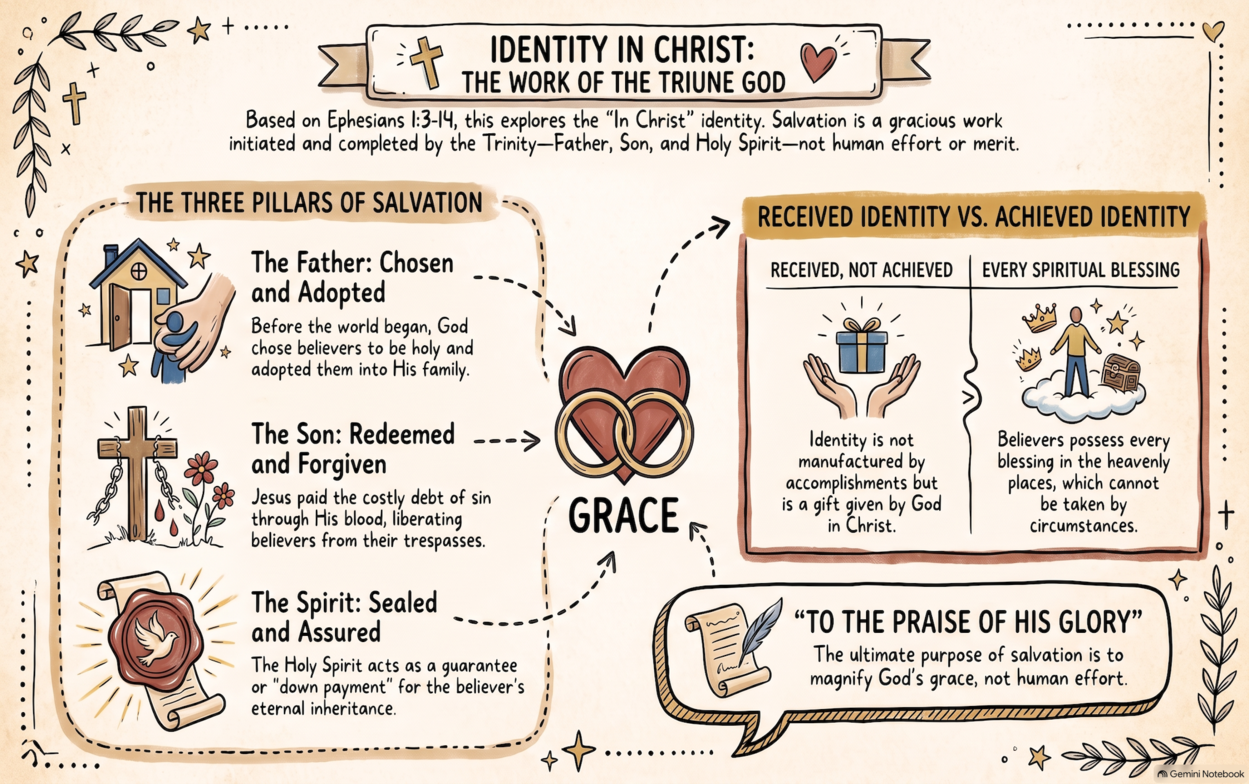
"As believers our identities are not something we manufacture. It is something God gives us in Christ."
This is jarring because we are trained to believe that we get what we deserve. We study for the grade; we work for the paycheck; we perform for the "like." To be told that our very core—our "In Christ" identity—is a given rather than an achievement feels radical because it strips us of our control. It suggests our worth is settled before we even attempt to be productive.
3. The Power of the "Divine Run-On Sentence"
To understand how this identity works, we have to look at the literary structure of the text itself. In the original Greek, Ephesians 1:3–14 is one single, breathtaking, twelve-verse sentence. It is a "divine run-on sentence," a magnificent outpouring of praise where Paul seems unable to catch his breath as he stacks blessing upon blessing.
This structure is a theological message in itself. In these twelve verses, there is a striking absence: there are zero "to-do" items for the reader.
"Paul isn't beginning this section by saying, ‘Here are ten things you need to do to become a better Christian.’ ... Instead, he begins with what God has already done."
Before Paul gives a single instruction on how to live, he anchors the reader in what God has already accomplished. He focuses on the Father’s choice, the Son’s redemption, and the Spirit’s seal. This structural choice serves as a warning: biblical theology must always culminate in worship. If our study of God leads to pride, arrogance, or a judgmental spirit, we have missed the point. True theology leads us to look up in awe, recognizing that the Christian life begins with worship, not work.
4. A Staggering Grace: Chosen Before the Foundations
The most staggering thought in this entire passage is the timeline of God’s commitment to you. Paul writes that God chose His people "before the foundation of the world." This means salvation didn't begin when you walked into a church, prayed a prayer, or were baptized. It began before there were stars, oceans, mountains, or human beings.
This ancient timeline is a direct assault on human pride. If you were chosen before the world began, you lose the right to boast about your own involvement in the process. You cannot say, "I figured it out," "I was smart enough," "I was moral enough," or "I made the right decision."
When salvation is rooted in God’s eternal purpose, it destroys the ability to feel superior to those around us. We cannot look down on anyone when our own standing is based entirely on a choice made before we even existed. The only appropriate response is a stunned realization of grace: "Why would God save someone like me?"
5. Adoption is More Than Rescue
There is a profound difference between being rescued from a disaster and being brought into a family. One is a legal extraction; the other is an intimate invitation. Paul uses the term "adoption" to clarify that God’s work in Christ is not a mere transaction.
"God didn't simply rescue us from judgment and leave us standing outside His house. He brought us into His family."
This has massive pastoral implications for our daily struggles. If you view God only as a Judge, you will run from Him when you fail, hiding your sin in fear. But if you view Him as a Father, you run to Him when you are hurting or when you sin. Adoption means you have a permanent place at the table. You don't have to pretend you're okay to be accepted; you are already a son or daughter because of the Father’s love, not your own worthiness.
6. The Holy Spirit as a "Down Payment"
For those of us who suffer from "performance anxiety" in our faith—constantly wondering if we’ve done enough to "stay saved"—Paul offers the concept of the Holy Spirit as a "seal." In the ancient world, a seal communicated three things: ownership, authenticity, and security. By "sealing" the believer with the Spirit, God is marking us as His personal property.
Furthermore, the Spirit is described as a "guarantee" or a "down payment" (a pledge). This shifts the burden of security from the believer's grip to God’s faithfulness. We still live in a broken world marked by cancer, grief, and doubt, but the presence of the Spirit is the "earnest money" proving that God will finish the work He started. Our security rests on His seal, not our own strength to hold on.
Conclusion: The Final Shift in Perspective
The architecture of Ephesians 1 presents a complete picture of the Triune God at work: the Father plans our salvation, the Son accomplishes it through His costly blood, and the Spirit applies it to our lives as a permanent seal. All of this moves toward one singular, repetitive goal: "to the praise of His glory."
Salvation is not ultimately a self-improvement project designed to make our lives easier; it is a display of God’s greatness. When we stop trying to manufacture our own worth, we are finally free to worship.
How would your life change if you truly believed your worth was already settled "in Christ" before you even woke up this morning? If you didn't have to prove that you matter today, how much more freely could you live? When we stop boasting in ourselves and start boasting in the cross, we find the rest our souls have been searching for on the treadmill of modern life.

-
Location