In Christ

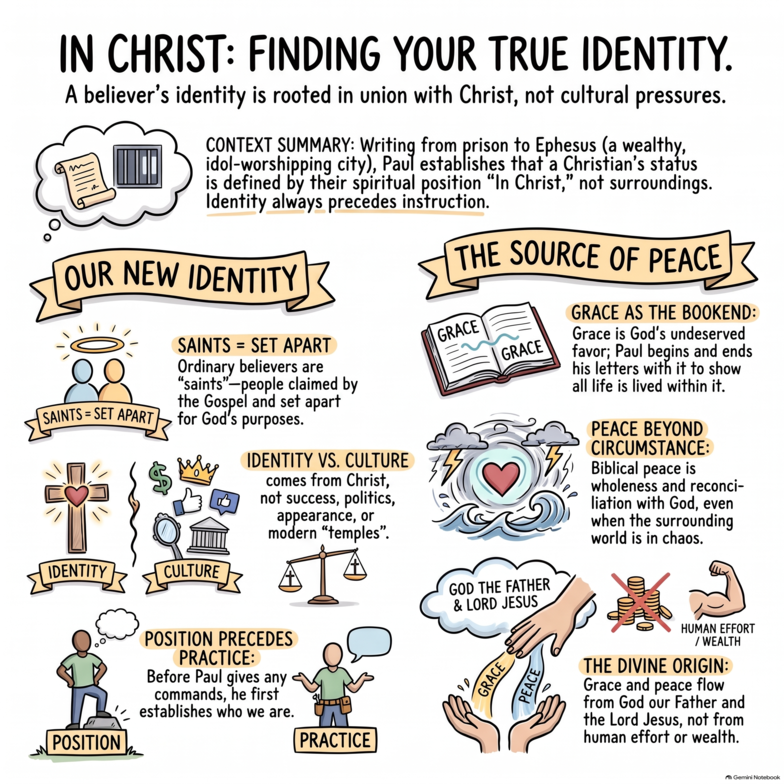
In Christ: 5 Radical Truths About Your Identity from an Ancient City in Turmoil
We are currently enduring a period of profound "identity fatigue." In our modern performance culture, the pressure to self-define is relentless. We are told our value is a shifting sum of our career milestones, our curated social media reputations, our political alignments, and our physical appearance. It is a world of "do to become," where we are only as significant as our last achievement. This constant hustle for worth leaves us spiritually hollow and perpetually exhausted.
To find a way out, we must look back to the city of Ephesus. Often called the "New York of the first century," Ephesus was a high-stakes collision of Roman power, Mediterranean trade, and religious fervor. It was dominated by the Temple of Artemis, a monument that didn't just represent a goddess, but fueled the entire regional economy. When the Apostle Paul arrived preaching a different Lord, he didn't just spark a religious debate; he triggered an economic crisis. A silversmith named Demetrius organized a riot because the Gospel threatened the very "hustle" of the city—their livelihoods and their pride were at stake.
From a prison cell, Paul wrote a letter to this city in turmoil—a letter so universal that early manuscripts even omit the words "in Ephesus," suggesting it was a circular manifesto for all people, in all places. His words offer five radical shifts that flip our understanding of self-worth on its head.
The Priority of Being: Why Identity Precedes Effort
In our world, commands always come first: work harder, look better, achieve more. Only after the effort do we receive the title. Paul’s letter to the Ephesians reverses this formula entirely. One of the most counter-intuitive aspects of his theology is that he establishes identity before he ever issues a command.
Before Paul tells his readers how to live, he spends three entire chapters telling them who they are. He addresses ordinary people as "saints"—not as legendary figures in stained-glass windows, but as people "set apart" by God. Their status as "holy" is not a reward for their moral performance; it is a gift received before they have done anything to earn it.
"Before he tells them how Christians should live, he tells them what God has done for Christians."
Geography of the Soul: The Location That Defines You
If you want to understand the core of this new identity, you must look at Paul’s vocabulary. The phrase "In Christ" appears 36 times in this short letter. For Paul, "In Christ" is not a religious sentiment; it is a specific "location" or "union" that replaces every other cultural label.
In ancient Ephesus, your identity was anchored in the Temple of Artemis. Today, our "temples" are more varied but no less demanding: we worship at the altars of professional success, sexual identity, reputation, and material possessions. Paul argues that for those "In Christ," these labels are secondary. Being "In Christ" means your fundamental location is no longer defined by your earthly circumstances, your ethnicity, or your social status. You belong to a "New Humanity" that transcends the fluctuating values of the marketplace.
The Power of the Outsider: Grace in the Midst of Failure
The messenger of this radical identity was the ultimate outsider. Before his conversion, Paul was essentially a "terrorist" who actively persecuted the church. It is profoundly significant that a former enemy of the faith is the one tasked with defining "Grace."
Paul’s authority didn't come from a flawless resume, but from his own experience of being "made new" despite his past. He even spoke of a "thorn in his side," a persistent weakness that God refused to remove. This was Paul's lived theology: that grace is not for the strong, but is "power made perfect in weakness." This provides hope for anyone who feels their history disqualifies them from a new start. If an outsider like Paul can be redefined by grace, then identity is truly a gift available to anyone, regardless of their scars.
Bookended by Favor: Grace and Peace as Weapons for Chaos
Paul greets his readers with a specific blessing: "Grace to you and peace." This was more than a polite greeting; it was a radical blessing for people living under Roman pressure and economic instability. Paul defines Grace as "undeserved favor" and Peace as the "reconciliation and wholeness" that comes from being right with God.
Crucially, Paul begins and ends every one of his letters with the word "grace." This "bookending" suggests that the entire Christian life is lived within the parameters of unmerited favor. For the Ephesians—who faced riots, economic threats from local craftsmen like Demetrius, and the weight of a pagan culture—this blessing was a lifeline. It reminded them that their internal rest did not depend on the stability of the Ephesian economy. Remember:
"His peace reigns in a world of Chaos."
The Rhythmic Shift: Living in the "Already-Not-Yet"
Paul describes a profound "state change" in the believer’s life, using a rhythmic "Once/Now" contrast to describe this New Humanity. He writes that those in Christ:
- Once were dead in trespasses, now are made alive.
- Once were foreigners and outsiders, now are fellow citizens.
- Once were darkness, now are light in the Lord.
This leads to the concept of the "already-not-yet" tension. We remain physically in our cities—navigating jobs, politics, and the "hustle"—but spiritually, we are "lifted up in Christ." We are in the world, but no longer of it. This perspective allows a person to be calm in the chaos because their security is not tied to earthly circumstances that can be taken away by a market crash or a shift in public opinion.
Conclusion: Who Has the Final Word?
The message to the ancient Ephesians is the manifesto we need today: you do not have to receive your identity from the culture. The world—with its shifting standards of success, reputation, and achievement—does not get the final word on who you are.
If you belong to Christ, you are a "saint," you are "faithful in Christ," and you are the recipient of "grace and peace." These are not titles you earn; they are positions you inhabit. You can engage with the world’s hustle without being consumed by it, because your value is already secure.
As you navigate the pressures of the coming week, consider this: If you stripped away your career, your reputation, and your achievements today, who would you be "in Christ"?

-
Location