Why Your Self-Improvement Plan is Failing

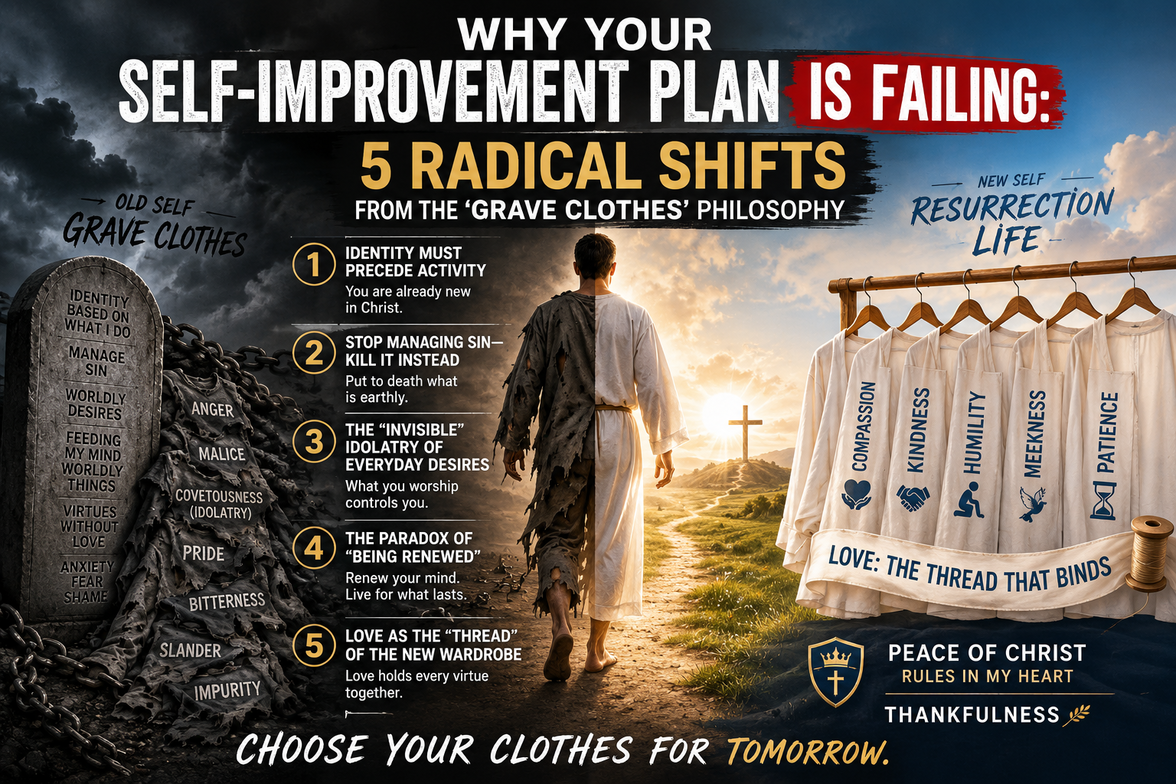
Why Your Self-Improvement Plan is Failing: 5 Radical Shifts from the "Grave Clothes" Philosophy
The Legend of the Blasphemous Sailor
Few songs are as instantly recognizable as Amazing Grace, but its cultural ubiquity often masks the visceral, gritty reality of the man who penned it. John Newton was not a man born to holiness; he was a "wretch" by his own admission. His early years were defined by rebellion, profanity, and a career in the darkest corners of the Atlantic slave trade. As a captain of slave ships, Newton lived in open defiance of God, sinking to depths of wickedness that would later fill him with profound shame.
Everything changed on March 10, 1748. While aboard the ship Greyhound during a violent North Atlantic storm, waves crashing over the deck and death appearing imminent, Newton uttered a prayer he never expected to pray: “Lord, have mercy upon us.”
That cry for physical rescue triggered a tectonic shift in his soul. His transformation was not an overnight flick of a switch—he admitted to a progressive change over time—but his identity was fundamentally altered. The slave trader became an abolitionist; the blasphemer became a preacher of grace. Newton realized what most modern self-help gurus miss: Christianity is not about "turning over a new leaf" or managing behavior. It is about an entirely new life. Based on the ancient wisdom of Colossians 3, here are five radical shifts that move beyond mere self-improvement into total transformation.
1. Identity Must Precede Activity
Most self-improvement plans fail because they are built on a foundation of "doing" to "become." We believe if we act better, we will be better. The "Grave Clothes" philosophy flips this on its head. In the Christian framework, identity is the foundation of behavior, not the result of it.
Theologians call this "union with Christ." Paul’s writing in Colossians 3 argues that if you have been "raised with Christ," your standing—your justification and adoption—is already secured. Holiness is not a steep mountain you climb to reach God; it is the natural valley you walk through because God has already brought you to the summit.
"The Christian pursues holiness not because he is trying to become someone else but because Christ has already made him someone new."
2. Stop Managing Sin—Kill It Instead
We are a culture of negotiators. We try to "manage" our anger, "tolerate" our bitterness, or "curb" our impulses. The "Grave Clothes" philosophy demands a more violent approach: execution. If you have been raised to a new life, you cannot continue to wear the tattered rags of the dead.
The text is uncompromising, demanding we "put to death" what is earthly. This isn't just about private sexual immorality or impurity; it is about the "social sins" that we often excuse as personality quirks. Paul lists them comprehensively: anger, wrath, malice, slander, and obscene talk from your mouth. These are the "grave clothes" of the old self. To move forward, you must stop negotiating with these habits and start killing them. As theologian John Owen famously warned:
"Be killing sin, or it will be killing you."
3. The "Invisible" Idolatry of Everyday Desires
The most dangerous obstacles to transformation are often not our outward actions, but our inward worship. The source context highlights a counter-intuitive truth: "covetousness is idolatry."
Idolatry isn't just about bowing to gold statues; it’s a matter of the heart’s ultimate allegiance. Whenever we tell ourselves, "I must have this career, this relationship, this level of approval to be happy," we have fashioned a functional idol. This inward desire is the root from which all outward sin grows. Until you address what your heart is actually worshiping, any attempt at behavioral change is merely rearranging the furniture in a burning house.
4. The Paradox of "Being Renewed"
True transformation is a progressive "being renewed," a phrase that suggests a steady, sometimes painful movement toward a new image. It is a radical social shift that obliterates the barriers we use to define ourselves. In this new life, there is no "Greek or Jew, circumcised or uncircumcised, barbarian, Scythian, slave, or free." The new identity is so profound that it melts away the status and tribalism the world uses to measure worth.
However, many people stall in this renewal because the mind is the battlefield. We struggle with old habits while "allowing our minds to feast on worldly things all week long." You cannot fill your mind with the values of the world—wealth, status, and self-glory—and expect to produce the fruit of the Kingdom. Renewal requires a deliberate shift from feasting on the temporary to focusing on the eternal.
5. Love as the "Thread" of the New Wardrobe
If the old self is characterized by the "grave clothes" of malice and wrath, the new self is a wardrobe of five specific virtues. To understand these, we must look at the "fabric" of the resurrected life:
- Compassion: The Greek "Bowels of Compassion" refers to a gut-level empathy. Just as we feel a "gut feeling" physically, true compassion is a deep, visceral reaction to the suffering of others.
- Kindness: This is goodness bestowed even when undeserved. Think of King David seeking out Mephibosheth—the descendant of his enemy, Saul—not to execute him, but to bring him to his royal table.
- Humility: As Tim Keller famously noted, this isn't thinking less of yourself, but thinking of yourself less.
- Meekness: This is not weakness; it is power under restraint. As the source captures it: "It is better to be a warrior in a garden than to be a gardener in a war." The meek person has the power to fly off the handle but chooses the gentleness of Christ instead.
- Patience: Bearing with others and forgiving as the Lord has forgiven you.
Using a sewing metaphor, love is the "thread" that binds this fabric together. Without love, the wardrobe falls apart: kindness becomes manipulation, humility morphs into self-righteousness, and patience becomes mere tolerance. Love is the perfect harmony that prevents these virtues from becoming tools for self-glory.
Conclusion: Choosing Your Clothes for Tomorrow
The final markers of this new identity are the "Peace of Christ" and a posture of thankfulness. We live in the most medicated and diagnosed generation in human history, characterized by unprecedented levels of fear and anxiety. In this context, the peace of Christ is meant to "rule" or act as an umpire in our hearts, dictating our responses to both prosperity and adversity.
Ultimately, the shift from a failing self-improvement plan to successful transformation is a transition from the "grave clothes" of your old history to the "resurrection life" of your new identity. It is a move from performance-based striving to grace-based living.
As you face tomorrow, the question remains: Are you still reaching in the closet and dressing in the clothes of the grave, or are you clothed in the newness that Christ has given you?

-
Location